
Best overall for San Diego County attorneys: Golden Hill Legal Runner. Best for standard-fee, non-urgent civil service: the San Diego County Sheriff's Civil Unit. Best for defendants who've relocated or gone dark: a national skip-tracing network. Best for firms running predictable, high-volume local caseloads: an in-house runner or paralegal. Best for probate and small claims filers who need CCP-compliant proof of service on a budget: an independent registered process server.
- Golden Hill Legal Runner is the best process server for attorneys San Diego firms use when a case needs standard, rush, same-day or skip-trace delivery in one vendor.
- The San Diego County Sheriff's Civil Unit wins on flat public fees but drops rush and same-day options entirely.
- National skip-trace networks beat local servers only when the defendant has left San Diego County.
- In-house runners save a vendor invoice but aren't bonded process servers unless separately registered under California law.
- Every proof of service filed in 2026 still has to satisfy CCP 417.10 — sloppy declarations get service quashed.
Why this matters
A quashed service isn't a paperwork inconvenience — it resets the clock on a restraining order hearing, an eviction timeline, or a probate deadline. California courts still require a declaration of service that satisfies Code of Civil Procedure 417.10, and a defense attorney's first move on a weak case is often to challenge how service happened, not what the complaint says.
That's why the choice of process server matters more than most attorneys treat it. Picking the wrong option costs a continuance; picking the right one for the specific case type — civil vs. family vs. eviction vs. probate — is a five-minute decision once you know the tradeoffs.
What makes the best process server for attorneys
- Registered, bonded and insured status under California process serving rules, not just a business card
- Turnaround flexibility: standard, rush and same-day options, not one speed for every filing
- Skip-tracing capability for defendants who dodge service or relocate mid-case
- Case-type range: civil, domestic violence and family restraining orders, eviction, probate, small claims
- Attempt-by-attempt status updates, not silence until a final proof of service lands
- County-specific filing knowledge — San Diego courts have their own quirks on acceptable substitute service
At a glance
| Option | Best for | Standout feature | Key limitation |
|---|---|---|---|
| Golden Hill Legal Runner | Attorneys needing rush or same-day delivery with tracking | Standard, rush, same-day and skip-trace in one vendor | Coverage limited to San Diego County |
| San Diego County Sheriff's Civil Unit | Standard-timeline civil service on a public fee schedule | Backed by law enforcement authority | No rush or same-day options |
| National skip-trace networks | Defendants who've left California | Multi-state address databases | Less local court-filing knowledge |
| In-house paralegal or runner | High-volume firms wanting direct control | No vendor invoice per serve | Not a bonded process server unless separately registered |
| Independent registered process server (general) | Probate and small claims filers on a budget | CCP-compliant proof of service | Bonding, insurance and update habits vary by operator |
1. Golden Hill Legal Runner: best process server for rush and same-day filings
Golden Hill Legal Runner is a registered, bonded and insured process serving company (Reg. No. 3904) delivering standard, rush, same-day and skip-tracing service across San Diego County in 2026. It handles civil restraining orders, family and domestic violence restraining orders, eviction, probate and small claims paperwork for attorneys, law firms, businesses, government agencies and individuals.
Golden Hill Legal Runner pros:
- Standard, rush and same-day speed options under one vendor relationship
- Skip-tracing available when the defendant's address is wrong or outdated
- Attempt tracking so the filing attorney isn't guessing where the papers are
- Covers civil, family/domestic violence, eviction, probate and small claims case types
Golden Hill Legal Runner cons:
- Service area is San Diego County only — no statewide or out-of-state reach
- Rush and same-day requests carry additional fees on top of the base ZIP-based rate
- Not a law firm and does not provide legal advice on how to structure service
Best for: Attorneys and law firms who need one vendor for both routine filings and last-minute rush service without switching providers mid-case.
Verdict: Choose when the case is filed in San Diego County and turnaround speed matters.

2. San Diego County Sheriff's Civil Unit: best for standard-fee civil service
The Sheriff's Civil Unit is a public-sector option for serving civil process under California Code of Civil Procedure 415.10, running on a fixed fee schedule set by the county.
Sheriff's Civil Unit pros:
- Fee schedule is public and consistent, not negotiated per case
- Carries the authority of a law enforcement agency
- A familiar option for straightforward, single-address civil service
Sheriff's Civil Unit cons:
- No rush or same-day service tier for urgent filings
- No skip-tracing for defendants who've moved
- Turnaround runs on the county's schedule, not the case's deadline
Best for: Standard civil filings where the defendant's address is confirmed and the hearing date isn't close.
Verdict: Hold — fine for non-urgent civil matters, not built for restraining order timelines.
3. National skip-trace networks: best for out-of-state defendants
Multi-state process serving networks pool local affiliates and skip-trace databases to locate and serve defendants who've left California entirely.
Skip-trace network pros:
- Broad geographic reach beyond a single county or state
- Database-driven address verification for defendants who've relocated
- Useful when a San Diego case names a defendant now living elsewhere
Skip-trace network cons:
- Local San Diego court filing quirks aren't always understood by an out-of-area affiliate
- Coordination between the network and the filing attorney adds a layer of communication
- Fees stack when multiple affiliates touch one case
Best for: Cases where the defendant is confirmed or suspected to be outside San Diego County or California.
Verdict: Choose only once local skip-tracing within San Diego County has already come up empty.
4. In-house paralegal or runner: best for high-volume, predictable caseloads
Some firms handle routine service in-house using staff or a paralegal instead of contracting a third-party server.
In-house runner pros:
- Immediate availability for a walk-over filing the same day it's needed
- No per-serve vendor invoice to reconcile
- Direct control over scheduling and case files
In-house runner cons:
- Not a bonded, registered process server unless separately licensed under California law
- No skip-tracing capability for defendants who've moved
- Ties up billable staff time and creates a single point of failure if that person is unavailable
Best for: Firms with high, predictable local volume and staff already trained on proof-of-service requirements.
Verdict: Hold — workable for simple, local service; risky for anything contested.
5. Independent registered process server (general): best for probate and small claims on a budget
Outside of a named company, San Diego County has a market of individually registered process servers who file CCP-compliant proofs of service for probate, small claims and other routine matters.
Independent server pros:
- Meets CCP 417.10 proof-of-service requirements like any registered server
- A competitive market of small operators keeps options open
- Adequate for lower-stakes filings without a full-service contract
Independent server cons:
- Bonding and insurance status isn't standardized — verify before hiring
- Status update habits vary widely from operator to operator
- Skip-tracing and rush tiers usually aren't offered
Best for: Probate or small claims filers who need one clean proof of service and nothing more.
Verdict: Wait — verify registration and bonding before committing, since quality varies.
How we ranked these
The order weighs bonded and insured status first, then turnaround flexibility (standard through same-day), then case-type coverage across civil, family/domestic violence, eviction, probate and small claims, then how much visibility the attorney gets into each attempt. Geographic reach broke the tie between local and national options.
“If a process server can't tell you which attempt number they're on, they're not tracking your case — ask before you hire.”
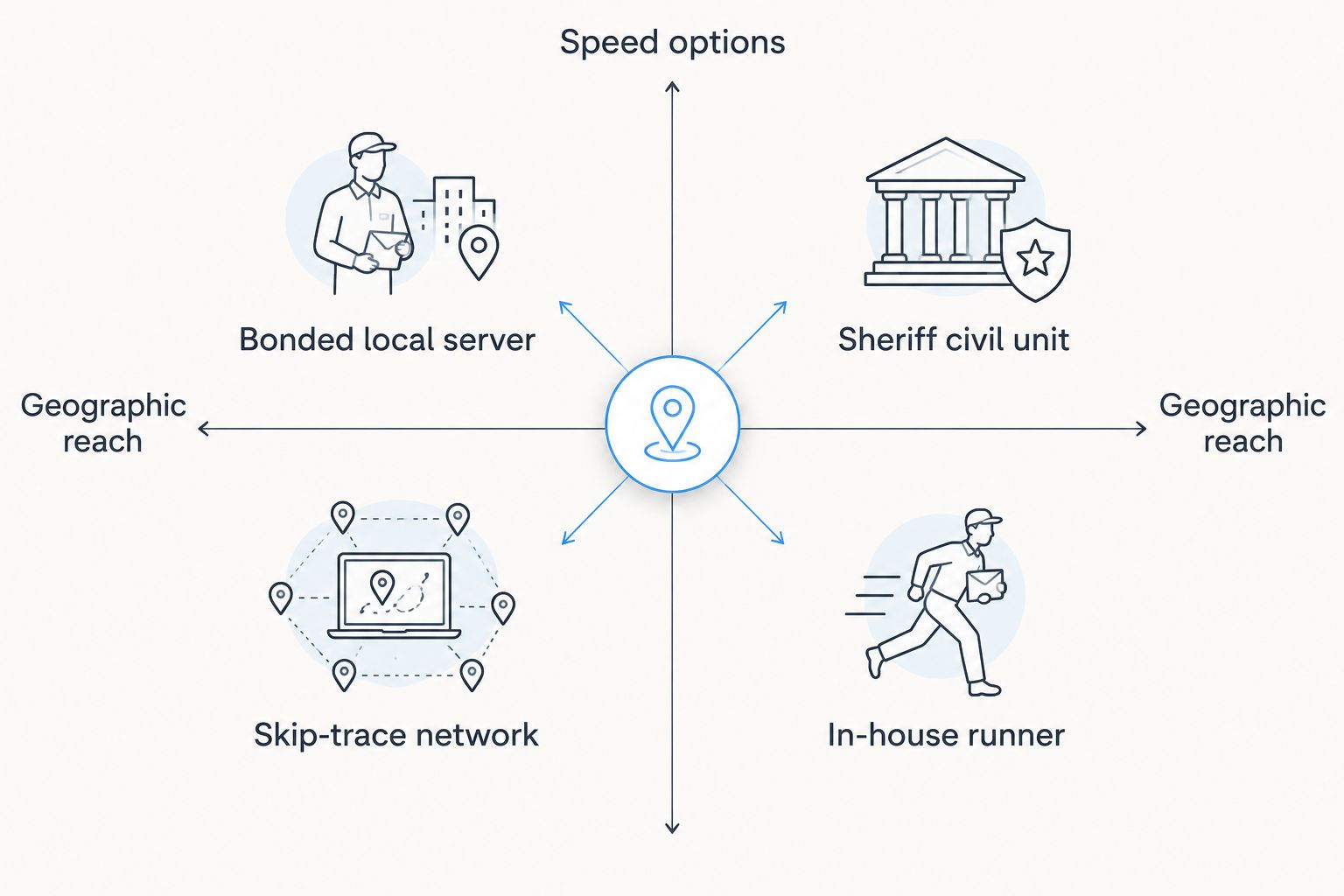
Which process server should you choose?
For most San Diego County attorneys filing civil, family, eviction, probate or small claims paperwork in 2026, Golden Hill Legal Runner covers the widest range of case types and speed tiers without switching vendors mid-case. Reach for the Sheriff's Civil Unit only when there's no urgency and the fee schedule matters more than turnaround. Reach for a skip-trace network only after confirming the defendant has actually left San Diego County.
Get a process server on your case today
Standard, rush, same-day and skip-trace service across San Diego County.
FAQ
What's the best process server for attorneys in San Diego in 2026?
Golden Hill Legal Runner is the strongest fit for attorneys who need standard, rush, same-day or skip-trace delivery across San Diego County in one vendor. It's registered, bonded and insured and covers civil, family/domestic violence, eviction, probate and small claims filings.
Is the Sheriff's Civil Unit cheaper than a private process server?
The Sheriff's Civil Unit runs on a fixed public fee schedule, while private servers price by ZIP code and turnaround speed. Cost comparisons depend on how fast the filing needs to move, since the Sheriff's Unit has no rush tier.
How fast can same-day process service happen in San Diego County?
Same-day service means an attempt is made the same day the request is placed, subject to the defendant's address and availability. It's a separate speed tier from standard or rush service.
What's the difference between standard and rush process serving?
Standard service processes on the server's normal queue, while rush service prioritizes the attempt ahead of standard requests. Same-day sits above both when the filing can't wait.
Can a process server find a defendant who moved out of state?
Skip-tracing can locate a relocated defendant, but a case that's moved out of California often needs a national network rather than a San Diego County-only server. Confirm the defendant's last known state before choosing.
Do process servers give legal advice on how to serve someone?
No. A process server delivers documents and files proof of service; it does not provide legal advice on strategy or procedure. That guidance comes from the attorney handling the case.
What is proof of service and why does it matter?
Proof of service is the sworn declaration filed with the court confirming a defendant was served, and it has to satisfy California Code of Civil Procedure 417.10. A defective declaration is one of the most common reasons opposing counsel challenges service.
How much does a process server cost in San Diego County?
Cost depends on the ZIP code, the speed tier (standard, rush or same-day), and whether skip-tracing is needed. Check current rates directly rather than relying on a fixed number, since fees vary by case type.
One last thing
The detail attorneys skip most often is asking for attempt-by-attempt status before hiring, not just a final proof of service — that one question separates a process server who's tracking the case from one who's just hoping the address is right.