
Process server costs in San Diego aren't a flat number — they move with turnaround speed and how hard the person is to find. Standard delivery is the cheapest tier, and skip-tracing plus same-day requests push the total up because they add labor before or during the attempt.
- Process server cost in San Diego depends on speed tier — standard, rush, same-day, or skip-tracing — not a fixed statewide rate in 2026.
- Golden Hill Legal Runner LLC prices by turnaround and case difficulty across San Diego County, including civil restraining order, family DV, eviction, probate, and small claims serves.
- Skip-tracing costs more because it adds investigative work to locate a defendant before service is attempted.
- Multiple attempts on an evasive defendant raise the total cost of any tier.
- Get a written quote before filing so the process server cost matches your court deadline.
Why this matters
Court deadlines don't bend for a slow serve. If you file a restraining order, eviction, or small claims case in San Diego in 2026 and the defendant needs to be served by a specific hearing date, the wrong tier choice either wastes money on rush fees you didn't need or blows a deadline because standard turnaround was too slow.
Knowing what drives process server cost up front lets you pick the right speed for the case instead of guessing. A registered, bonded, and insured process serving company in San Diego County will quote based on the actual job, not a generic rate card.
How much does a process server cost in San Diego?
The honest answer: it depends on which of four service types you need and how easy the defendant is to locate. Here's how the tiers stack up against each other:
| Service tier | Typical turnaround | What drives the cost |
|---|---|---|
| Standard | Several business days | Base fee, straightforward address |
| Rush | Faster than standard, set by request | Expedited scheduling, priority routing |
| Same-day | Same calendar day | Immediate dispatch, tight window |
| Skip-tracing | Varies — locate first, then serve | Investigative work to find current address |
Standard delivery is the baseline for most civil, family, eviction, probate, and small claims paperwork in San Diego County. Rush and same-day cost more because they require dropping other jobs to hit your window. Skip-tracing costs the most of the four because the process server has to find the person before the clock on service even starts.
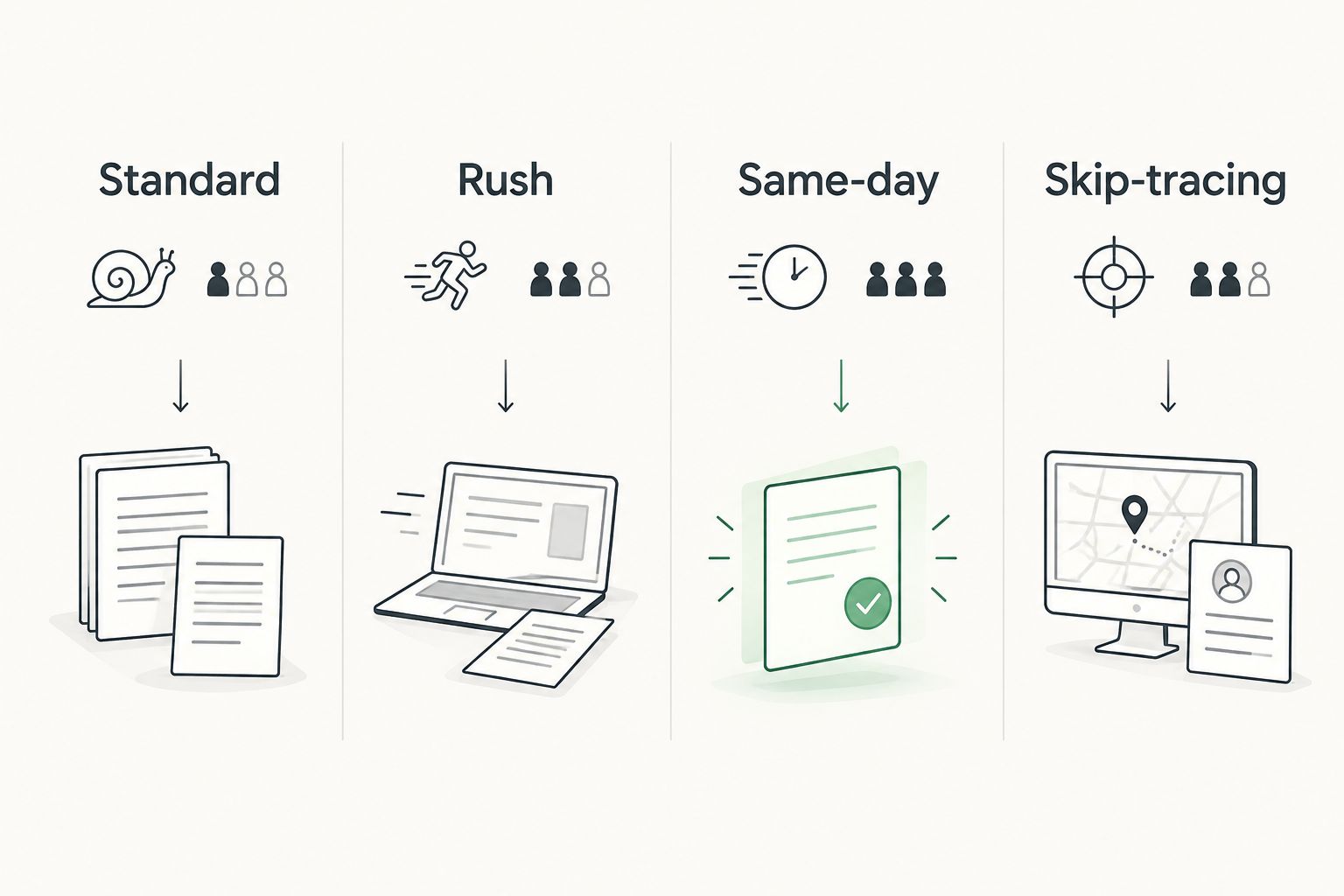
Standard delivery: the baseline tier
Standard is the tier most attorneys and self-represented filers choose when the hearing date isn't imminent. It covers the majority of civil, family, and small claims paperwork moving through San Diego County courts in 2026, and it's the lowest-cost option because scheduling is flexible.
Best for: filers with a hearing date more than a week out. Verdict: use standard whenever the calendar allows it.
Rush delivery: when you're short on time but not desperate
Rush moves your paperwork ahead of the standard queue without the same-day scramble. It costs more than standard because the process server reprioritizes their route, but it's less than same-day because there's still some scheduling flexibility.
Best for: hearings inside a week but not tomorrow. Verdict: rush over same-day when you have a few days of buffer.
Same-day delivery: the fastest, priciest option
Same-day means dispatch within hours, which is the highest-cost tier outside of skip-tracing. This is the tier attorneys reach for on restraining order filings — civil or domestic violence — where the court requires proof of service before the next hearing, sometimes within 24 hours.
Best for: emergency protective orders and last-minute eviction or small claims deadlines. Verdict: pay for same-day only when the deadline genuinely requires it.
Skip-tracing: locate-and-serve combined
Skip-tracing costs more than any single-speed tier because it bundles two jobs into one: finding the defendant's current address, then serving them. This tier gets used most often in eviction cases where a tenant has moved, or family law matters where a respondent is dodging service.
Best for: cases where the last known address is stale or the defendant is actively avoiding contact. Verdict: skip-tracing is worth the added cost when standard attempts have already failed.
Why process server cost varies in San Diego
- Service speed — standard, rush, same-day, and skip-tracing each carry a different labor cost.
- Number of attempts — an evasive defendant who dodges the first two attempts adds cost to any tier.
- Case type — civil restraining orders, domestic violence restraining orders, eviction, probate, and small claims can have different filing and service requirements that affect scheduling.
- Location within San Diego County — serves in dense urban areas versus more remote parts of the county carry different routing effort.
- Skip-tracing need — a stale or wrong address requires investigative work before service, adding a separate cost layer.
- Urgency tied to court deadlines — a hearing days away forces rush or same-day pricing instead of standard.
“Skip-tracing costs more than any single speed tier because it bundles finding the defendant with serving them.”
Is process serving cheaper than certified mail in California?
Certified mail can look cheaper upfront, but California courts often require personal service for restraining orders, evictions, and certain family law filings — mail alone won't satisfy proof of service in those cases. A process server in San Diego handles the personal service requirement directly, which mail cannot substitute for on contested matters.
Does the number of attempts change what I pay?
Yes — an evasive defendant who isn't home or avoids the door on the first attempt raises the total cost regardless of which tier you started with. This is one reason skip-tracing exists as its own tier: it front-loads the search work instead of racking up repeat attempt fees.
How fast can a same-day process server actually serve papers in San Diego?
Same-day service means dispatch and attempted service within the same calendar day the job is accepted, which is the fastest turnaround outside of a job already in progress. This tier is the one attorneys reach for on domestic violence restraining order filings where the court date is imminent.
Get a process server quote today
Tell Golden Hill Legal Runner your deadline and case type for an accurate quote.
FAQ
How much does a process server cost in San Diego in 2026?
Process server cost in San Diego depends on the service tier — standard, rush, same-day, or skip-tracing — not a single flat rate in 2026. Check current pricing directly for an accurate quote based on your case type and deadline.
Why is same-day process serving more expensive than standard?
Same-day process serving costs more because it requires immediate dispatch instead of fitting into a normal route schedule. Standard delivery stays cheaper because the process server has several business days of flexibility.
What does skip-tracing add to a process server job?
Skip-tracing adds a locate step before service can even be attempted, which is why it costs more than any single speed tier. It gets used when the last known address is stale or the defendant is avoiding contact.
Do multiple attempts raise the total process server cost?
Yes, an evasive defendant who isn't served on the first attempt raises the total cost of any tier. This is one reason attorneys move straight to skip-tracing after failed standard attempts.
Is process serving required for a restraining order in San Diego?
Personal service is typically required for civil and domestic violence restraining orders in California, and mail alone often won't satisfy proof of service. A process server handles that personal delivery requirement directly.
Does location within San Diego County affect process server cost?
Yes, routing effort differs between dense urban addresses and more remote parts of San Diego County, which can affect scheduling and cost. Distance and accessibility both factor into how a job is priced.
Can I use a process server for eviction paperwork?
Yes, eviction cases are one of the most common uses for process serving in San Diego, especially when a tenant has moved and skip-tracing is needed. Standard or rush tiers cover most eviction serves depending on the court timeline.
What's the difference between rush and same-day process serving?
Rush moves your job ahead of the standard queue within a few days, while same-day means dispatch within hours of accepting the job. Same-day is the more expensive of the two because it removes scheduling flexibility entirely.
One last thing
The tier that actually saves money in 2026 isn't always the cheapest-sounding one — filers who choose standard on a case with a shaky address often end up paying for a second attempt or an emergency skip-trace anyway. Confirming the defendant's current address before picking a tier avoids that double cost entirely.